
The Royal Marines at Trafalgar - Captain Charles William Adair and HMS Victory
On 21 October 1805, Captain Charles William Adair stood aboard HMS Victory as the British fleet approached a combined French and Spanish force off Cape Trafalgar.
Adair was not a sailor, nor was he one of the admirals whose names would become inseparable from the battle. He was a Royal Marines officer, responsible for the detachment of Marines serving aboard Nelson's flagship, and as Victory moved towards the enemy, he and his men were preparing for some of the most dangerous fighting they would ever experience. Adair would not survive the day.
More than two centuries later, his portrait, sword, lorgnette and pistol survive in the Royal Navy Museums collection. Together with the accounts and possessions of other Royal Marines who fought at Trafalgar, these objects help us understand a battle often remembered through its commanders and warships by returning us to the people who experienced it.
The Royal Marines aboard HMS Victory
By October 1805, Britain had been at war with France for more than two years, and the Royal Navy was preparing to confront a combined French and Spanish fleet that threatened British control of the seas.
Nelson's plan was to divide his fleet into two columns and break through the enemy line, accepting the danger of approaching under heavy fire in order to bring British ships into close combat. For the men aboard HMS Victory, the leading ship in Nelson's column, this meant enduring enemy fire before they could fully bring their own weapons to bear.
Among those preparing for battle were the Royal Marines, who served aboard Royal Navy warships as a disciplined fighting force. Their duties included guarding vital areas of the ship, maintaining security, using muskets against enemy personnel and helping repel boarding parties when opposing vessels came alongside. Another role was assisting with the great guns. Of the 147 Marines on board, only 40 were stationed on the upper deck at the outset of the battle, the remaining number were dispersed around the gun crews but could be called upon as reinforcements if needed.
These responsibilities placed Marines in some of the most exposed positions during naval combat, particularly when ships became locked together and fighting included muskets and close-quarter combat as well as cannon fire.
Aboard Victory, the detachment was commanded by Captain Charles William Adair, supported by fellow officers including 2nd Lieutenants Lewis Buckle Reeves and Lewis Roteley. They were about to take part in a battle that would become one of the defining events in Royal Navy history.
Captain Charles William Adair's final battle
As HMS Victory advanced towards the combined French and Spanish fleet, she came under heavy fire. The danger increased as she broke through the enemy line and became engaged with the French ship Redoutable, whose crew fought fiercely from the decks and rigging.
With the two ships alongside one another, the Royal Marines aboard Victory had an important role in defending the ship against enemy musket fire and the threat of boarding. Adair was among those directing the defence.
According to the historical account recorded by the Royal Navy, he was encouraging his men to repel boarders when he was struck by a musket ball in the back of the neck and killed. His death came during the same battle in which Nelson was mortally wounded, but while Nelson's final hours have become one of the best-known stories in British naval history, Adair's experience is far less familiar. Yet the objects he left behind allow us to recover something of his story.
The objects that connect us to Captain Adair
Among the objects preserved in the Royal Navy Museums collection is a portrait of Captain Charles William Adair, painted by an unknown artist. The portrait has undergone conservation, supported by The Company of Arts Scholars Charitable Trust, helping preserve an important visual record of a man whose life ended aboard HMS Victory.
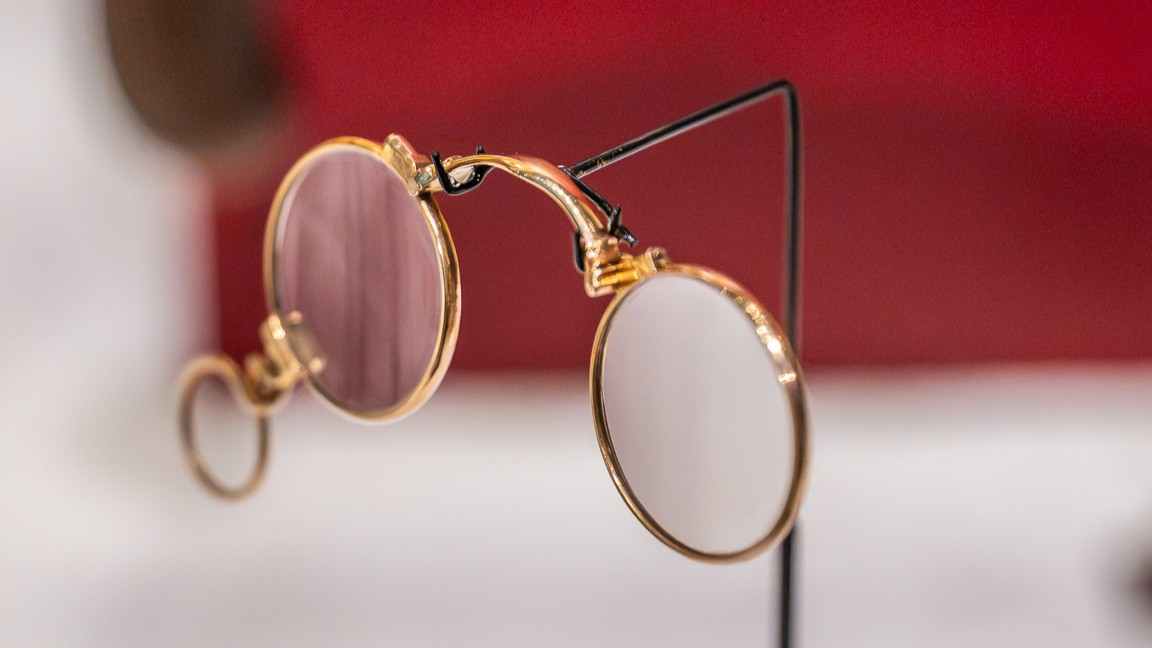
Alongside it are personal objects associated with Adair, including his dress sword and lorgnette, an optical aid. A prerequisite to becoming an officer was the ability to read and write, so they could understand and write orders and official communication. A lorgnette was more of an accessory with many others choosing to wear spectacles. His choice of a lorgnette gives us an idea of his sense of style, which can also be seen in the elaborate decoration of his sword hilt.
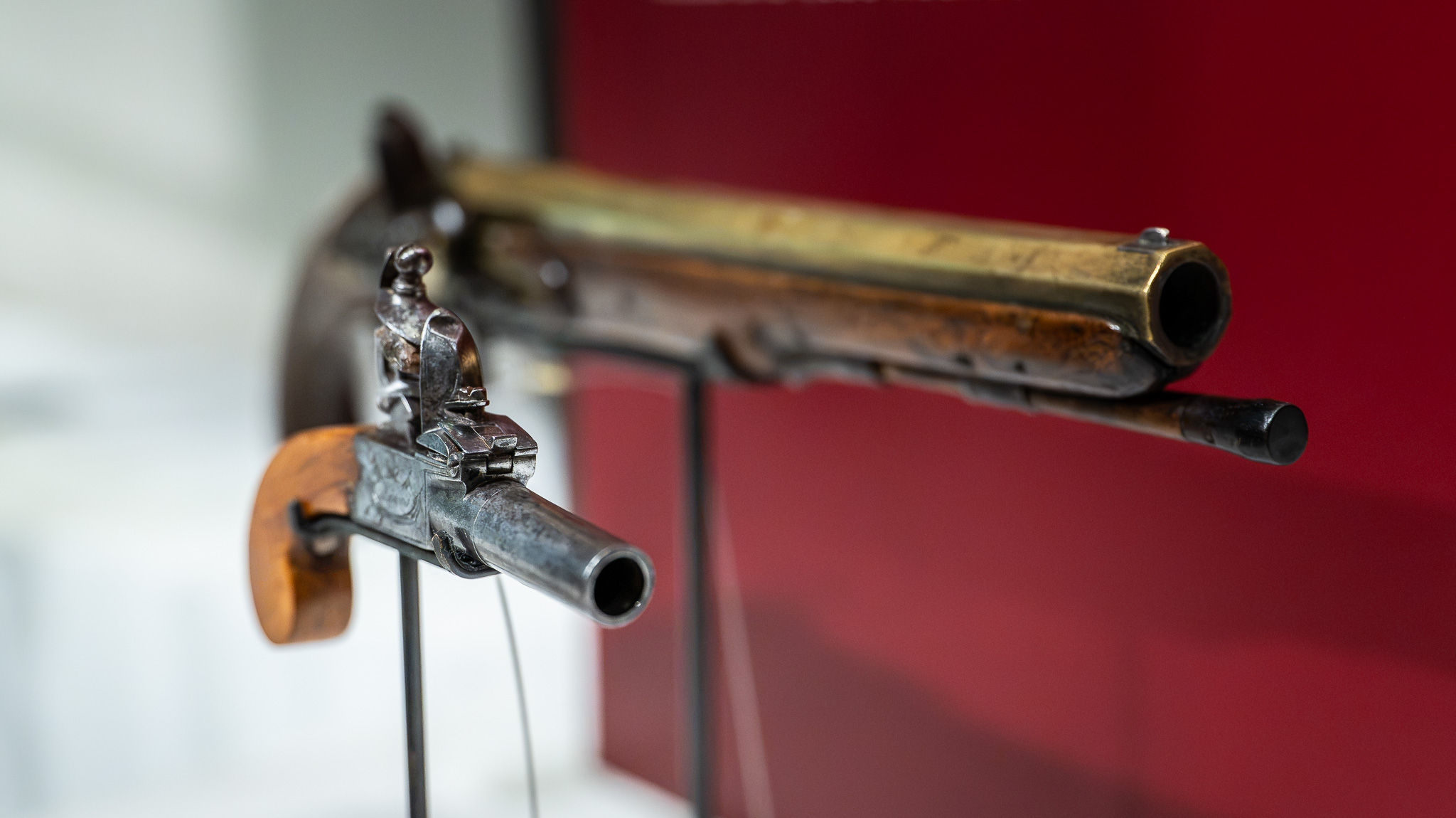
A small flintlock pistol carried by Adair aboard Victory at Trafalgar also survives in the collection. These objects reveal different aspects of his life as an officer.
His sword and portrait reflect the identity and status of a Royal Marines captain, while the pistol connects him more directly to his service aboard a warship preparing for battle. Taken together, they provide something that the familiar paintings of Trafalgar cannot. They allow us to encounter an individual who stood on Victory's decks that day, rather than seeing him only as one of the many casualties recorded after the fighting.
The preservation of these objects also means that Adair's story can be told alongside those of the other Marines who served aboard Victory, including men who survived and carried their memories of the battle into later life.
The Royal Marines who survived Trafalgar
Not every Royal Marine aboard HMS Victory was killed during the fighting, and the experiences of those who survived provide another perspective on the battle.
2nd Lieutenant Lewis Roteley was one of the Royal Marines officers serving aboard Victory. His surviving account offers an important connection to the men who fought alongside Adair and witnessed the events of 21 October 1805. Where a medal or official record might tell us where someone served and what recognition they received, personal testimony can help us understand how those events were experienced and remembered.
The contrast between Adair and Roteley is particularly significant. Adair had served throughout the French Revolutionary Wars 1793-1802 and served on Victory from 1803. On the other hand, Roteley had only received his commission on 27 July 1805, and joined the ship in the September.
With the death of Adair, Roteley found himself the only Marine officer still on deck (both 2nd Lt Reeves and 1st Lt James Peake had been wounded and forced to leave the deck for treatment); so, only a few months into his career, Roteley (aged 20) took command of Victory’s Marines during the biggest battle of the age. He reflects on this in a letter to his father: “I assure you I am not a little proud of having had the honour of commanding the Marines on Lord Nelson’s ship, the Junior Lieutenant.”
He also comments on Adair’s death in the same letter: “Our Capt Adair, a truly brave man, was shot about the middle of the action and instantly expired. His death will be universally lamented by all who knew him.”
2nd Lieutenant Roteley was also wounded in the head during battle but played this down when writing to his father: “Myself received several slight scratches, but nothing to induce me to leave the deck”.
Their experiences remind us that the history of Trafalgar extends far beyond the death of Nelson. It is also the history of the sailors and Royal Marines who continued fighting around him, the men who were wounded or killed, and those who survived to return home.
Remembering the Royal Marines at Trafalgar
The Royal Navy Museums collection also preserves objects connected with other Royal Marines who served during the battle and the wider Napoleonic Wars.
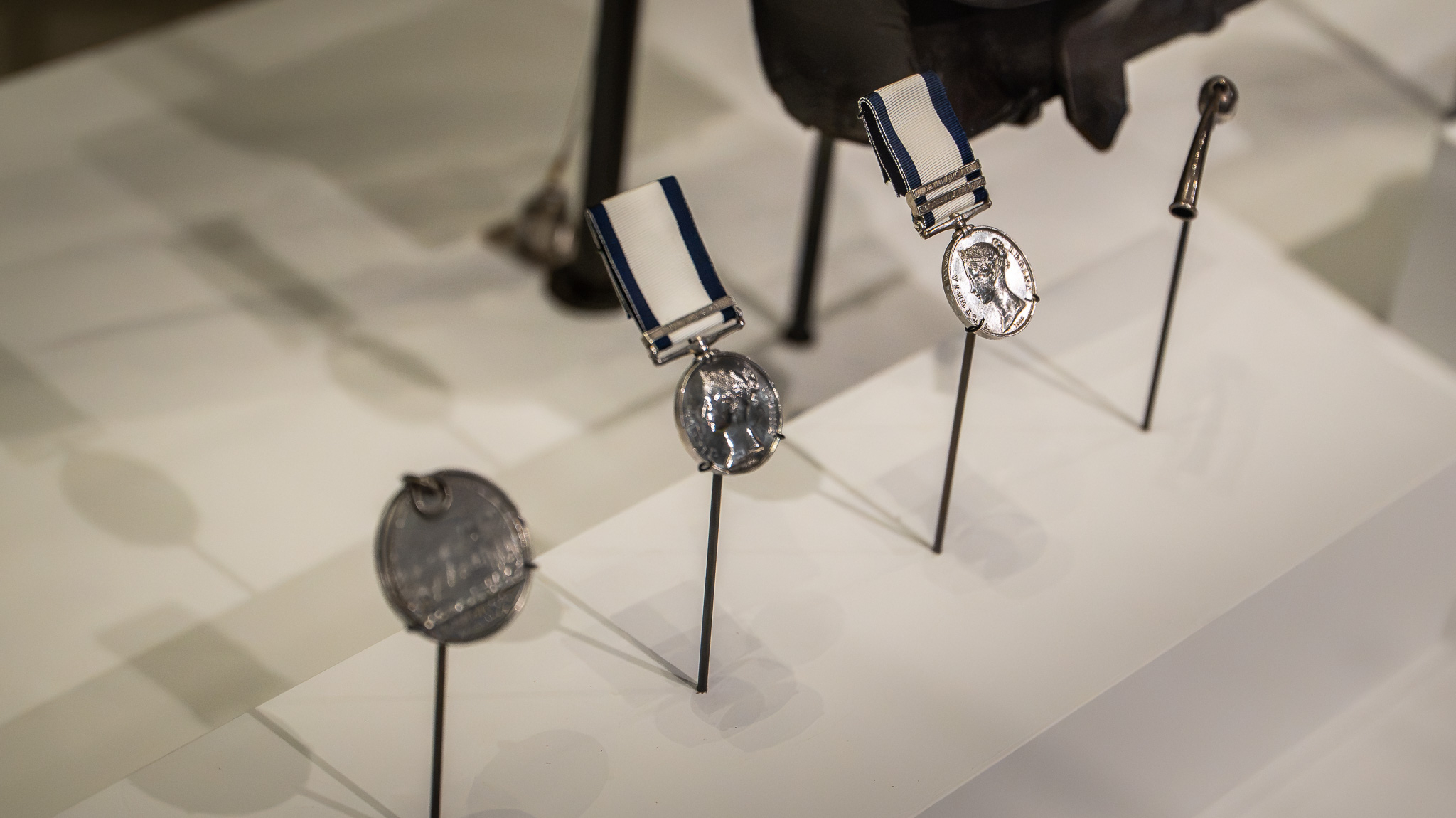
Among them is a Naval General Service Medal awarded to 2nd Lieutenant Lewis Buckle Reeves, another Royal Marines officer aboard HMS Victory, who was wounded in the forearm by grapeshot. We also have a medal awarded to George Underhill, a Royal Marine drummer who served aboard HMS Tonnant. Tonnant fought in the lee column at Trafalgar and captured the French ship Algésiras after fierce fighting. Underhill’s role is a reminder that drummers were not simply ceremonial figures. Their drum calls helped regulate life aboard ship and communicate orders, including the call for men to prepare for action.
Such medals were awarded years after the events they commemorated, recognising service that had taken place long before. They provide another link between the men who experienced the battle and the ways in which their service was remembered by later generations.
Alongside personal weapons, portraits and surviving accounts, they help build a fuller picture of the Royal Marines at Trafalgar, one that extends beyond the familiar names and events of the battle itself.
Their stories survive
More than 220 years after the Battle of Trafalgar, HMS Victory remains at Portsmouth, where visitors can still explore the decks on which Captain Adair and his fellow Royal Marines fought.
The ship provides an extraordinary physical connection to the battle, but it is through the objects and accounts preserved in the Royal Navy Museums collection that we can begin to discover the individuals who lived and served aboard her.
Captain Adair's portrait, sword and pistol tell us something about an officer whose life ended during the fighting. The surviving accounts of other Marines help preserve the experiences of those who returned, while medals and personal possessions reveal how their service continued to be remembered long after the battle.
These stories will form part of the new Royal Marines Experience, opening at Royal Navy Museums: Portsmouth on 24 October 2026.
Bringing together objects, personal accounts and more than 360 years of Royal Marines history, the Experience will explore the people behind the Green Beret, from the men who fought aboard wooden warships to the generations who followed them.
Discover the Royal Marines at Trafalgar through the people who lived that history, and the objects that ensure their stories can still be told today.
With research and editorial support from Ed Mayhew, Curator (Artefacts)