Icon article: Inside ‘The Big Repair’: An Archaeological Block-Lift of a Hull Fragment from HMS Victory
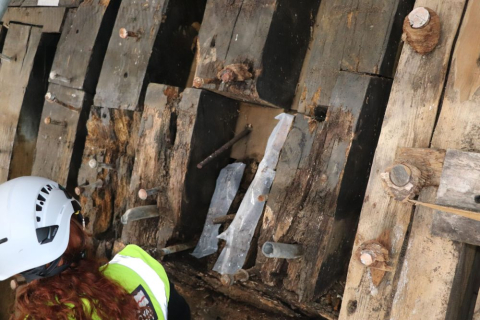
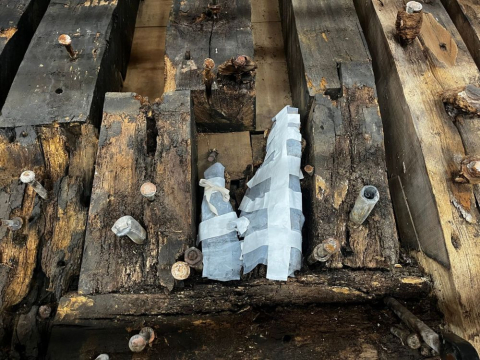
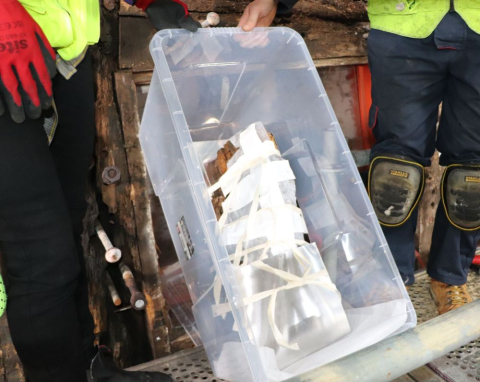
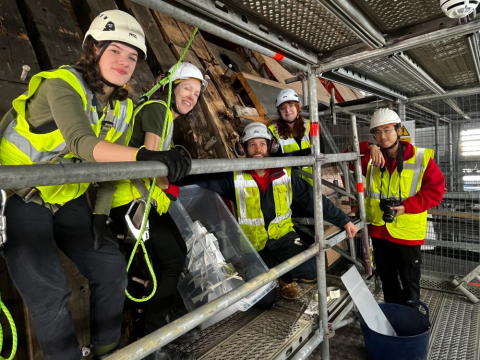
In December 2025, after months of material testing and research, members of HMS Victory: The Big Repair’s Conservation Team undertook an archaeological block-lift of a fragment of the ship’s hull. This removal now allows unhindered air flow around the remaining hull structure and also the first opportunity to examine the removed material up close.
HMS Victory (1765), once Vice-Admiral Lord Nelson’s flagship during the Battle of Trafalgar and still a commissioned Royal Navy vessel and flagship to this day, is currently three years into the decade long conservation project “HMS Victory: The Big Repair”. Due to exposure to weather for almost 250 years, HMS Victory has suffered extensive damage and ongoing deterioration – particularly to its starboard side. A team of conservators, archaeologists, heritage scientists, and traditional craftspeople (shipwrights and riggers) all work together to repair and conserve HMS Victory.
To allow the ongoing works, HMS Victory has been under scaffold cover since the very beginning of the conservation project in 2021. The scaffold structure offers a unique opportunity for staff to get up close to the ship and undertake the required work under cover, whilst at the same time enabling the public to view conservation in action from the “Victory: Live” viewing platforms.
Archaeological Significance and Context
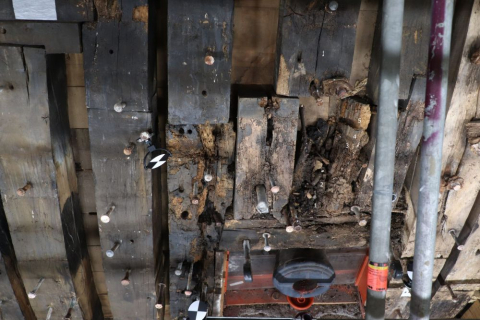
In December 2025, members of the Conservation team removed a heavily degraded section of oak futtock (reference number WPE2224) from HMS Victory’s port side. The futtocks form the supporting ‘ribs’ of the ship’s hull. Although dating to the 19th century, this futtock is set amongst a group of 1920s oak futtocks placed into the ship during the restoration, following its dry-docking in 1922. The oak futtocks survived an extensive phase of repairs in the 1980s-90s, which saw the replacement of many oak futtocks with teak. Replacements slowed down by 2000, when teak supplies were no longer available and, after a survey of the existing 1920s oak futtocks found them to be in good condition, the scope of repairs by the MoD was reduced.
The early futtock section (roughly 590mm length x 290mm width) that was removed is part of one of six futtocks surviving from the19th century, if not earlier, and was located towards the aft end of the port side of the ship. Due to its age, the futtock section is considered to be of exceptional heritage significance as one of the last remaining pre-1920s futtocks of the ship. The item’s surface is absent of bandsaw marks and has three treenails in-situ. The absence of bandsaw marks indicates the futtocks were hand-shaped after being roughly sawn from logs, confirming production in the early 19th century or at an earlier date. The removed section and its neighbouring futtocks to either side (which have bandsaw marks and are thought to date from the 1920s) and the gunport lintel below had degraded significantly compared to other nearby futtocks. This must have been historically an area of major water ingress, encouraging fungal action to degrade the timbers. These futtocks are also riddled with insect holes, likely to be of deathwatch beetle.
The futtock was so heavily degraded that it had effectively collapsed into two parts down the middle, with surrounding debris, which was filling the spaces to either side – ultimately decreasing airflow between the surrounding futtocks. The presence of debris in the spaces between futtocks inhibits airflow that enables the futtocks to dry out, thereby providing ideal conditions for fungi to grow and providing food for deathwatch beetle, amongst other insects. The structural failure of the futtock section also impacted the preservation of the original position of the treenails. Preserving the original alignment of the treenails is important as they still are in-situ in the futtocks, just like they would have been at the time of production. For these reasons it was decided to attempt removal and relocation to storage, thereby preserving the form of the futtock as far as possible, retaining the positions of the treenails and enabling the cleaning out of the debris from the space between the remaining futtocks. It is hoped that this will allow improved airflow around the futtocks and reduce the risk of favourable conditions for deathwatch beetle.